
Mathematics
Year 6's bakery is a huge success!
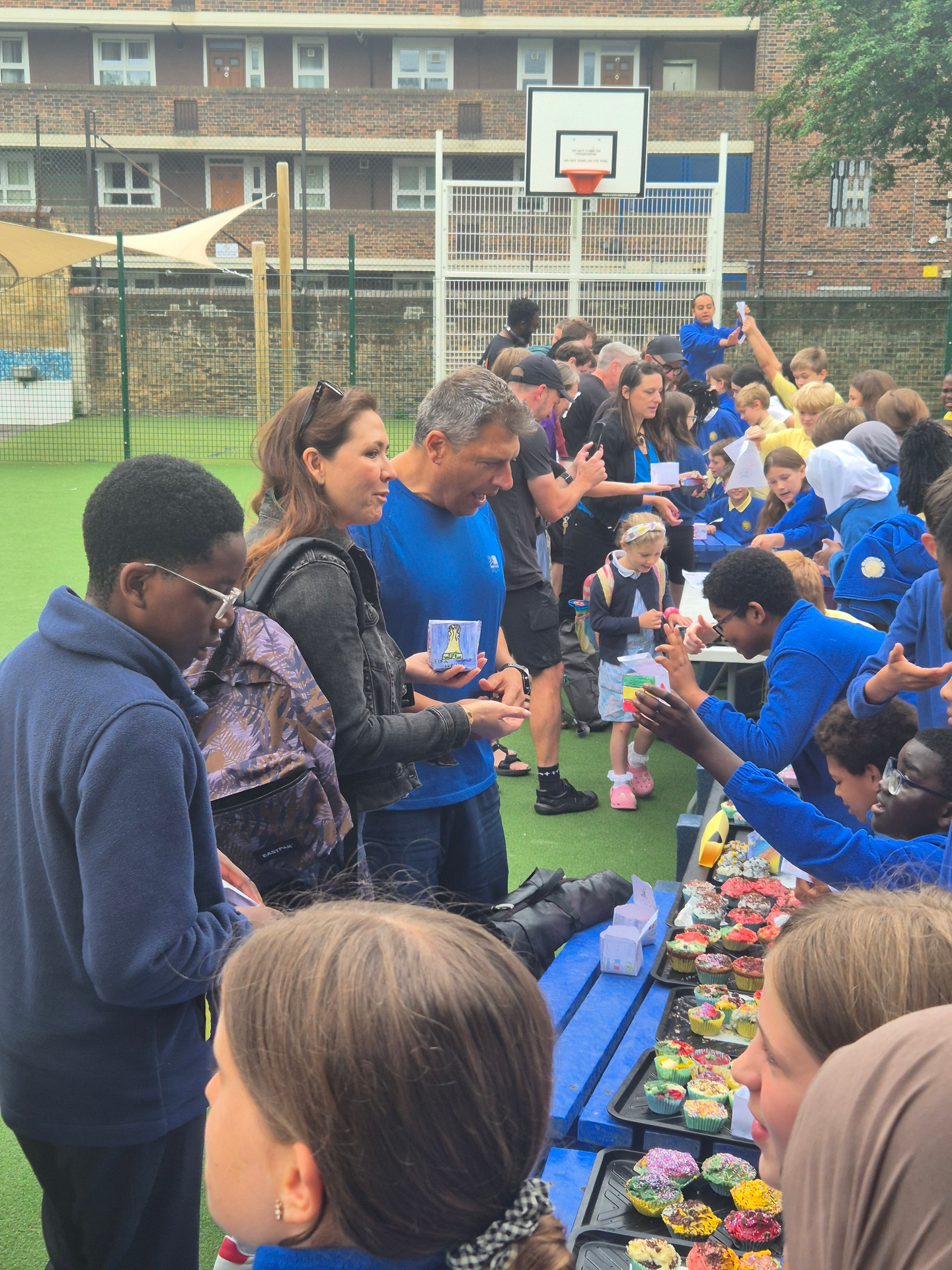
This morning, year 6 finally got to open their Bakery. It proved to be a huge success! The children have been working hard designing a business, creating a profitable product with enticing packaging and making their cupcakes to sell. Today was the day that members of the public (thank you parents!) were finally able to purchase the much anticipated cakes. Negotiations were fierce and varied and those who held out until the closing of the shop snapped up some bargains! Profits are currently being calculated but the children have made over £150 as well as negotiating nearly an hour of extra playtime - we definitely have some future CEOs amongst us! Well done for all your hard work year 6.
Counting coins in Year 2
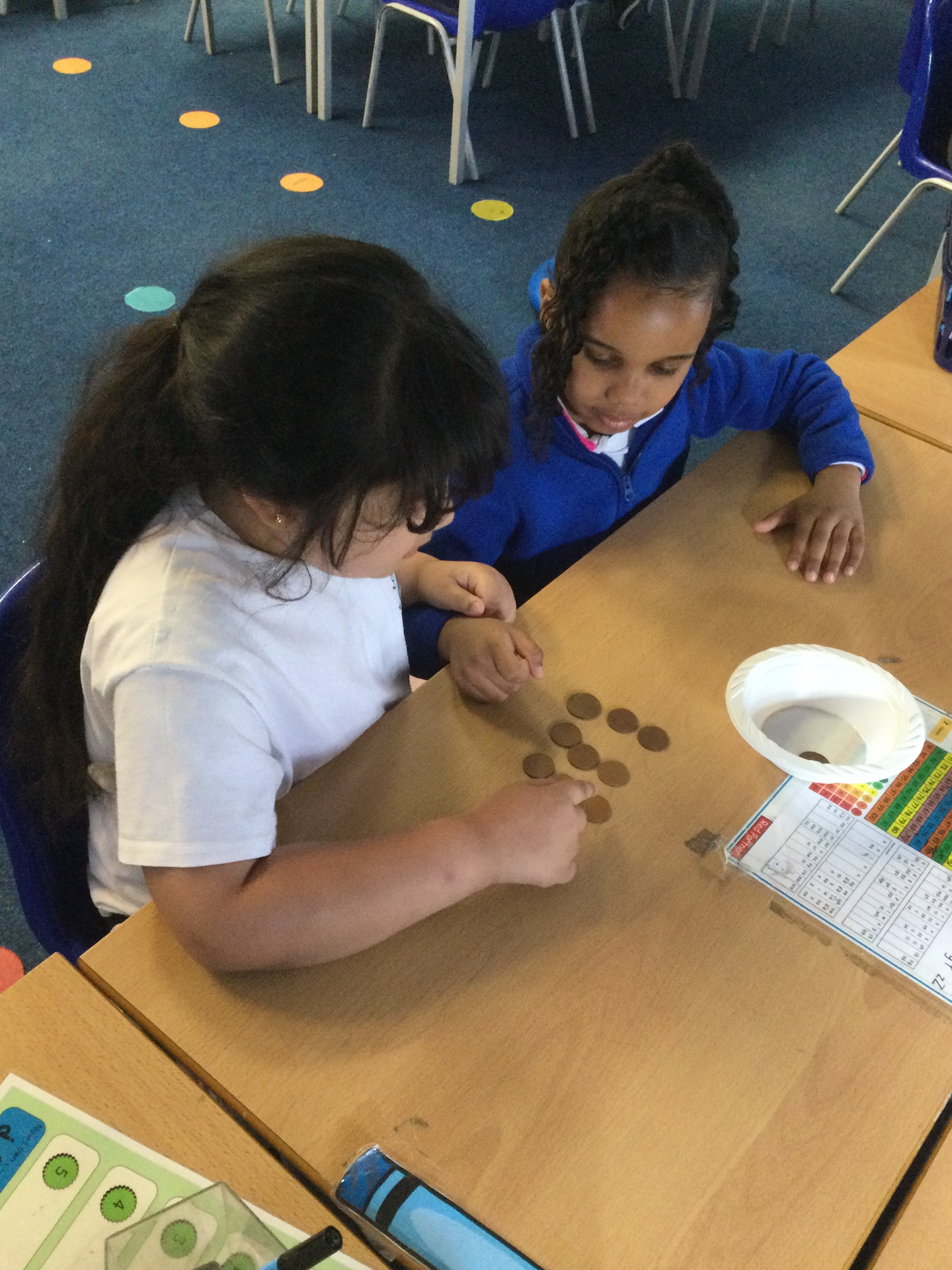
We are very excited to be learning all about money in Year 2! We started the topic today exploring the difference between copper and silver coins. We discovered we can use our skip-counting skills to find the total value of a number of coins. We had to pay special attention to each coin to make sure we knew how much each was worth.
We can't wait to learn about pound coins and notes in the lessons to come this week!
Understanding Geometry in Year 2
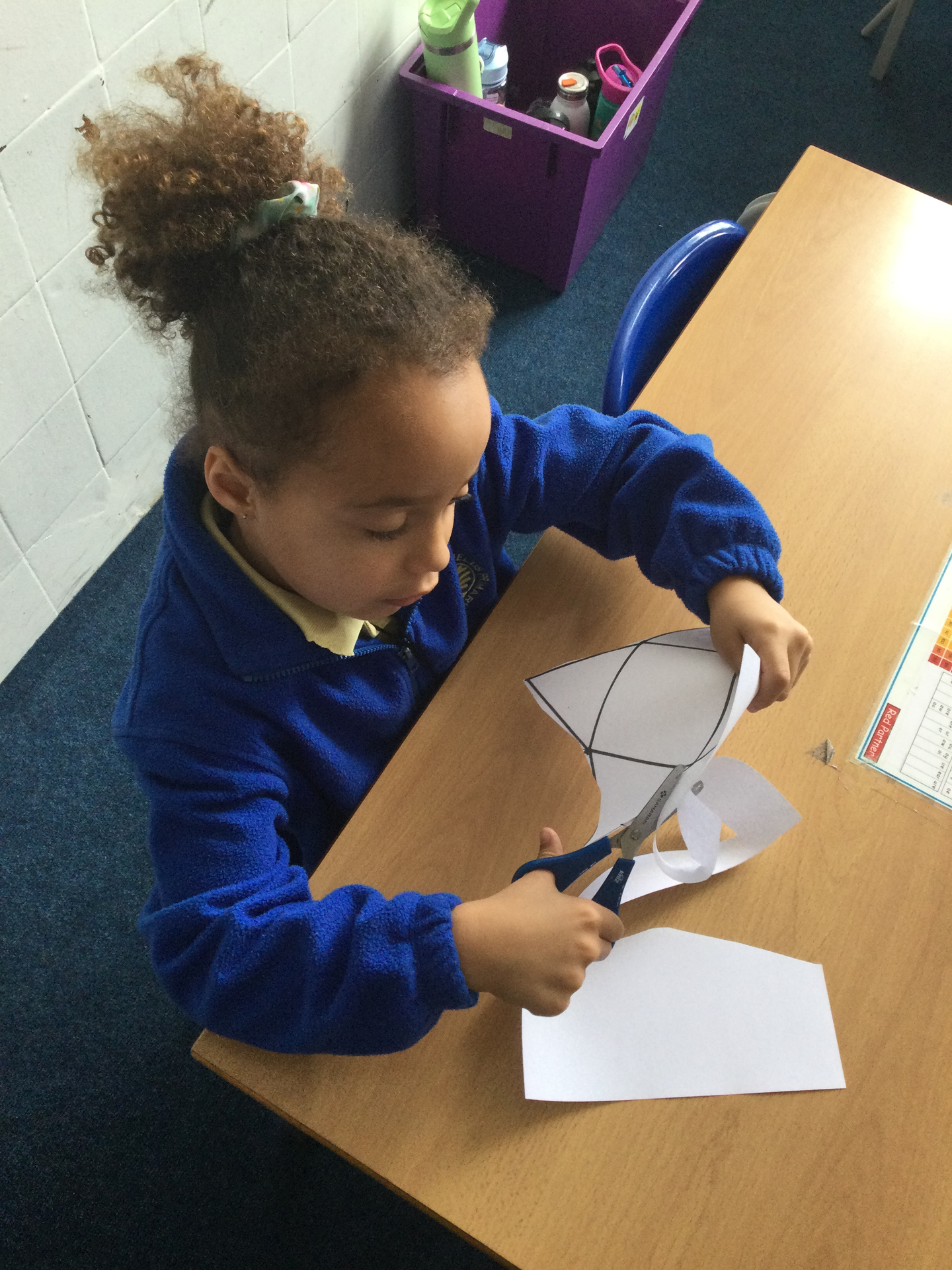
This week Year 2 learnt that 2D shapes can be joined together to make 3D shapes! We identified that a cuboid is made up of rectangular and square faces. We particularly enjoyed folding our own 3D shapes out of paper. We predicted beforehand what shape we were going to construct based on the faces our net had.
Mathematics at London Fields Primary School
Mathematics is an inter-connected and highly creative subject that has been developed over centuries, providing solutions to some of the world’s most interesting problems. It is essential to everyday life, academic discipline and employment, with the power to change lives. Our Maths curriculum has been designed so that pupils are taught to think mathematically so that they can understand numbers, geometry and measures.
At London Fields, we are passionate about our pupils leaving primary school with a sound foundation in the fundamentals of mathematics and the ability to reason, problem solve and follow lines of enquiry. Central to this is a sense of pleasure and curiosity about the subject we hope to foster throughout our whole school community. We believe that Maths is for everyone, and we promote a Growth Mindset in the way that children approach mathematical problems.
Our Mathematics curriculum is designed so that all children develop the essential characteristics of a mathematician and have:
- an understanding of the important concepts and an ability to make connections within Mathematics.
- a broad range of skills in using and applying Mathematics.
- fluent knowledge and recall of number facts and the number system.
- the ability to show initiative in solving problems in a wide range of contexts, including the new or unusual.
- the ability to think independently and to persevere when faced with challenges, showing a confidence of success.
- the ability to embrace the value of learning from mistakes and false starts.
- the ability to reason, generalise and make sense of solutions.
- fluency in performing written and mental calculations and mathematical techniques.
- a wide range of Mathematical vocabulary.
- a commitment and passion for the subject.
How is Mathematics taught at London Fields?
At London Fields, we use a 'Teaching for Mastery' approach to Mathematics. We also supplement our curriculum in Years 1-6 with a programme called Oak Academy. This a high quality scheme that supports our teachers to plan and deliver mathematically rich and supportive lessons. Each lesson provides opportunities for our pupils to intelligently practise, retrieve, refine and apply their mathematical knowledge.
Our Maths curriculum is designed to help pupils form a Maths schema within their long term memories. Schema theory states that all knowledge is organised into units. A schema is, therefore, a conceptual system for understanding knowledge. Our Maths schema is a way of organising mathematical semantic and procedural knowledge in a meaningful way; it is an appreciation of how knowledge is connected and the ways in which it is connected.
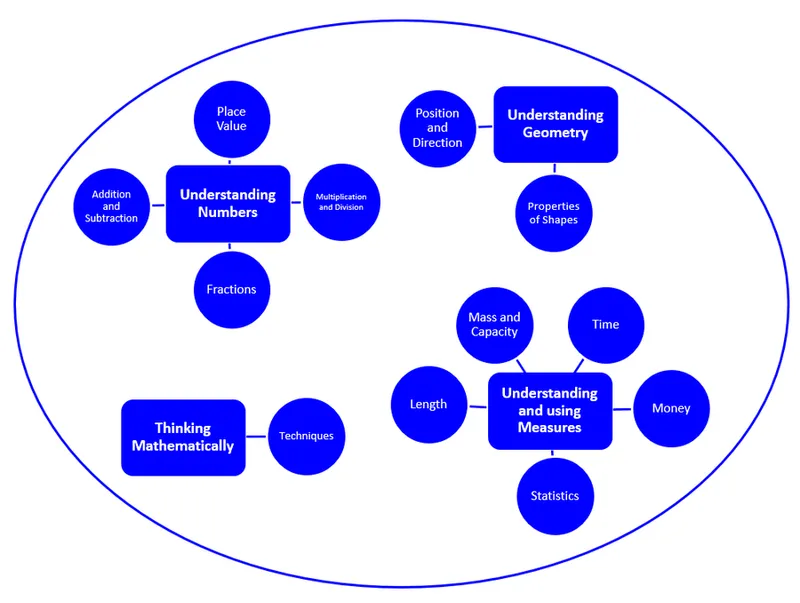
Big Ideas help form the basis of our Maths schema. Big Ideas are concepts that underpin the subject. In Maths, these are:
- Thinking Mathematically
- Understanding Numbers
- Understanding and using Measures
- Understanding Geometry
Each Big Idea has facets of knowledge (knowledge categories) which help to strengthen the schema. Learning knowledge in each of the categories allows pupils to express and demonstrate their understanding of the Big Idea, which gradually develops as pupils return to them over and over again.
What is ‘Teaching for Mastery’?
When taught to master Maths, children develop their conceptual and procedural fluency without having to resort to rote learning. As a result, they are able to solve non-routine problems in unfamiliar contexts without relying on memorised procedures. Not only do they understand how to solve problems, but can use their conceptual understanding to explain why their solution works.
We all learn together…
In Maths lessons at London Fields, where possible, the whole class moves through topics and concepts at broadly the same pace. We spend longer time on key mathematical topics and concepts in order to give all learners both the practice and depth of understanding they need. We believe that all pupils can achieve success in Maths. There is nobody who ‘can’t do Maths’.
We challenge pupils by asking them to explore mathematical concepts in more depth rather than accelerate them onto new content. This has been found to have real benefits to children’s ability to access more complex mathematical ideas as they get older.
We learn deeply…
We give our pupils enough time to explore core concepts and ideas in mathematics at a deep level in order to foster their relational and conceptual understanding. This slower pace and focus on depth eventually leads to greater progress because it gives all learners the chance to become secure. As a result, each year we are able to build new learning onto children’s existing knowledge.
We use representations…
At London Fields we use concrete apparatus (things pupils can touch, hold and manipulative) and visual representations (things they can see) to help children to visualise and internalise mathematical concepts. This allows them to access and understand the mathematical structure of the concepts they are learning about. Through the consistent use of these apparatus and representation, our pupils gain confidence as independent learners to use resources and solve problems.
Why the Mastery Teaching Approach?
Our approach is developed from mastery teaching approaches and pedagogy used by Singapore and other high performing territories. This has produced a high level of achievement for these areas. Singapore ranks first globally for achievement in Mathematics and has been within the top 5 nations since 1995. This is true for learners of all abilities, as the graph below demonstrates.
Our approach is also based on empirical research and sound educational theory. We have followed advice from theorists who are widely considered experts in maths education such as Jerome Bruner, Richard Skemp, Lev Vygotsky and Zoltan Dienes.
The Department for Education, the National Centre for Excellence in the Teaching of Mathematics (NCETM), the National Curriculum Review Committee and OFSTED have all emphasised the pedagogy of Mathematics teaching developed in Singapore and the teaching for mastery approach.
Mathematics across the curriculum
Pupils get to rehearse, apply and consolidate their Maths learning in other areas of the curriculum. Careful planning ensures pupils continue developing all areas of Maths in other subjects.
Mathematics at Home
We believe the best help you can give at home is to find ways to show children that Maths has purpose and relevance to their everyday lives. For example, if your child is in Reception or Year 1, talk about the numbers you can find on the way to school. If your child is in the middle of the school, count up coins when paying for things and ask if you have received the correct change. Meaningful experiences with Maths will not only help children see the purpose of learning about Maths at school but also give them practical mathematical experiences. Continued and deliberate practice of core knowledge, such as times tables and number bonds, is also a key way to support children in their Mathematics learning at home. By the end of Year 4, children should know all of their multiplication and division facts up to 12 x 12.
See below for a list of external resources to support learning at home:
National Numeracy – Parent Toolkit
Where can I find out more?
If you have any questions or concerns about Mathematics at London Fields or the mastery approach please don’t hesitate to get in touch with the Maths Lead, Alex Bentley. You can make an appointment to see her through the school office or by contacting the school email.